
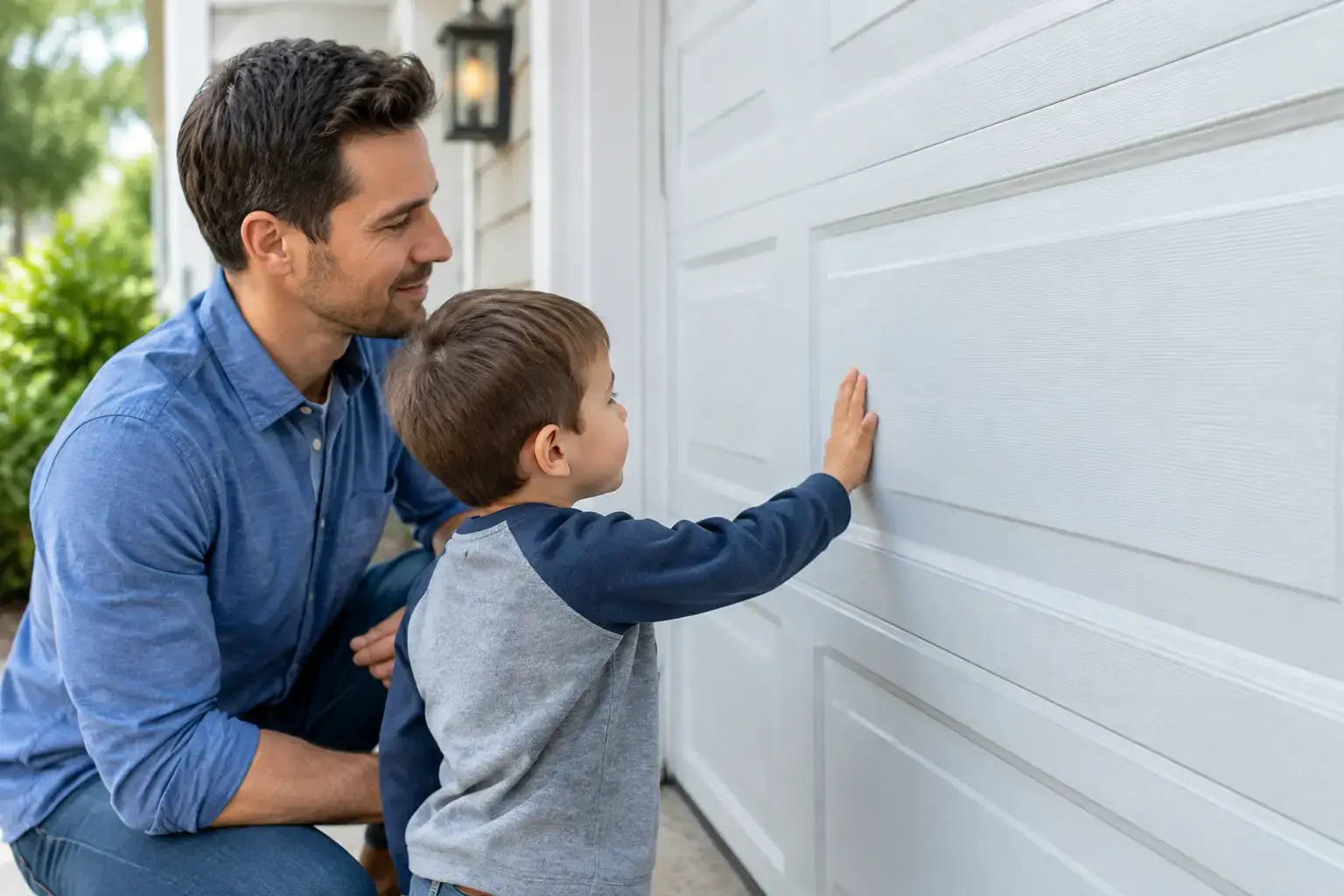
A garage door can weigh well over 100 pounds, move with enough force to cause a serious injury, and create pinch points that are easy for a child to overlook. That is why garage door child safety is not just about telling children to stay out of the way. It starts with a properly working door, a dependable safety system, and household rules everyone can follow.
For Greater Boston families, garages often serve as entryways, storage areas, workshops, and play-adjacent spaces. A few practical checks can reduce the risk of an accident and help you spot a problem before a door becomes unsafe to operate.
1. Test the auto-reverse feature every month
Modern automatic garage door openers use a reversing mechanism designed to stop and reverse the door when it contacts an object. This feature is one of the most important parts of garage door child safety, but it only helps if it is functioning correctly.
With the door fully open, place a solid object such as a piece of 2-by-4 lumber flat on the floor under the center of the door. Close the door using the wall button or remote. When the door touches the object, it should reverse promptly and return to the open position.
If the door continues down, stops without reversing, or reverses inconsistently, stop using the opener until a qualified technician can inspect it. Do not try to compensate by standing nearby or watching it closely. A door that fails this test needs adjustment or repair.
2. Check the photo-eye sensors and keep them clear
The photo-eye sensors are the small units mounted near the bottom of each garage door track. They send an invisible beam across the doorway. If a child, pet, bicycle, or other object breaks that beam while the door is closing, the opener should stop and reverse.
Look for steady indicator lights on both sensors. Blinking lights, no lights, or a door that closes only when you hold down the wall button can point to a sensor alignment, wiring, or opener issue. Dust, spiderwebs, leaves, road salt residue, and snow can also interfere with sensor performance, especially during Massachusetts winters.
Wipe the sensor lenses carefully with a soft cloth and make sure boxes, sports equipment, and vehicles are not blocking their path. Avoid taping, bypassing, or disconnecting the sensors. That may get the door moving temporarily, but it removes a critical safety protection.
3. Keep remotes, keypads, and wall controls out of reach
Children are naturally curious about buttons, remotes, and moving doors. Keep portable remotes where young children cannot access them, rather than leaving them on a low shelf, workbench, or in an unlocked vehicle parked outside.
The wall-mounted opener control should be installed high enough that small children cannot reach it. If your family uses a wireless keypad, teach children that it is not a toy and that they should never open the garage door for someone they do not know. For smart garage door controls, protect the app with a secure phone lock and do not share access codes casually.
It also helps to decide who in the household is responsible for checking that the door is fully closed at night. An open garage is both a safety concern and a security concern.
4. Teach children where pinch points are
A garage door does not need to fall to cause an injury. Fingers can be caught between door sections, near hinges, in the tracks, or around rollers and cables. Children should understand one clear rule: never touch a garage door while it is moving, and never stand beneath a door that is opening or closing.
Explain that the door is not a playground surface. Children should not race under it, hang from it, climb the tracks, ride near it on scooters, or use the remote as a game. The same applies to the automatic opener itself. Pulling on the emergency release cord or climbing on stored items near the opener can create a dangerous situation.
If you have older children, show them how to use the regular wall control appropriately, but make sure they know not to use the emergency release unless an adult directs them to do so. Releasing a door with a broken spring or damaged cable can allow the door to drop suddenly.
5. Never leave a partially open door unattended
A garage door that is only halfway open can be especially risky. Children may try to crawl beneath it, play around the opening, or pull on the bottom section. A door that will not stay fully open may have a spring, cable, track, or opener problem.
If the door stops before it reaches the floor, do not repeatedly run the opener in hopes that it will correct itself. If it will not open fully, keep people and vehicles away from the doorway and arrange for an inspection. A door that is crooked, shaking, hanging unevenly, or making loud banging sounds should be treated as unsafe.
The trade-off is straightforward: using a side entry door for a day may be inconvenient, but operating a visibly damaged garage door can create a much larger problem.
6. Inspect the door for warning signs
You do not need to identify every garage door part to notice when something is wrong. Once a month, watch the door complete one open-and-close cycle from a safe distance. It should move smoothly, remain level, and sound reasonably consistent.
Pay attention to frayed cables, loose hardware, bent tracks, damaged rollers, cracked panels, or gaps around the bottom of the door. Listen for scraping, grinding, popping, or straining from the opener. These symptoms do not always mean immediate failure, but they are good reasons to schedule a professional inspection before the issue worsens.
Do not attempt to adjust torsion springs, extension springs, cables, or bottom brackets yourself. These components are under extreme tension and can cause severe injury if handled incorrectly. Garage door maintenance such as cleaning sensor lenses and keeping the area clear is appropriate for homeowners. Spring and cable work is not a DIY repair.
7. Secure the garage as a storage space
Child safety includes what is inside the garage, not only the moving door. Store chemicals, fuel, sharp tools, ladders, and heavy equipment in locked cabinets or out of a child’s reach. Keep bicycles, strollers, balls, and outdoor toys away from the door tracks and photo-eye sensors.
A clear floor gives children less reason to play near the opening and makes it easier for adults to see whether anything is in the door’s path. If your garage is used as a family entryway, consider creating a designated storage zone away from the door so backpacks, shoes, and sports gear do not collect near the threshold.
Also check the emergency release cord. It should be visible and usable by an adult, but it should not hang low enough for a young child to grab or pull while playing. A technician can advise on safe placement if the cord is unusually long or accessible.
8. Schedule service when the door is not reliable
The safest garage door is one that is professionally installed, properly balanced, and maintained before small wear issues become failures. An annual tune-up is a sensible baseline for many homes, particularly if the door is used several times a day. Homes with older doors, heavy insulated doors, or frequent use may benefit from more regular attention.
During a professional service visit, a technician can inspect the springs, cables, rollers, tracks, hinges, opener force settings, photo-eyes, and auto-reverse system. They can also explain what is wearing out, what can wait, and what needs prompt repair. Clear answers matter when you are making a safety decision for your home.
If your garage door will not close, has come off its track, has a broken spring, or is behaving unpredictably, keep children away from the area and avoid operating it. Triple A Garage Doors Inc. provides qualified, insured service with upfront communication so homeowners can address a dangerous door without guessing about the next step.
Make safety part of the household routine
Children learn safety best through consistent habits, not one-time warnings. Test the reversal system, keep controls secure, clear the sensor area, and remind children that a moving garage door is never something to run under or touch. When the door starts sounding or moving differently, treat that change as useful information rather than something to ignore.
A garage door should open and close quietly, predictably, and safely in the background of family life. If it cannot do that, it is time to have it checked before a close call becomes an injury.
Leave A Comment