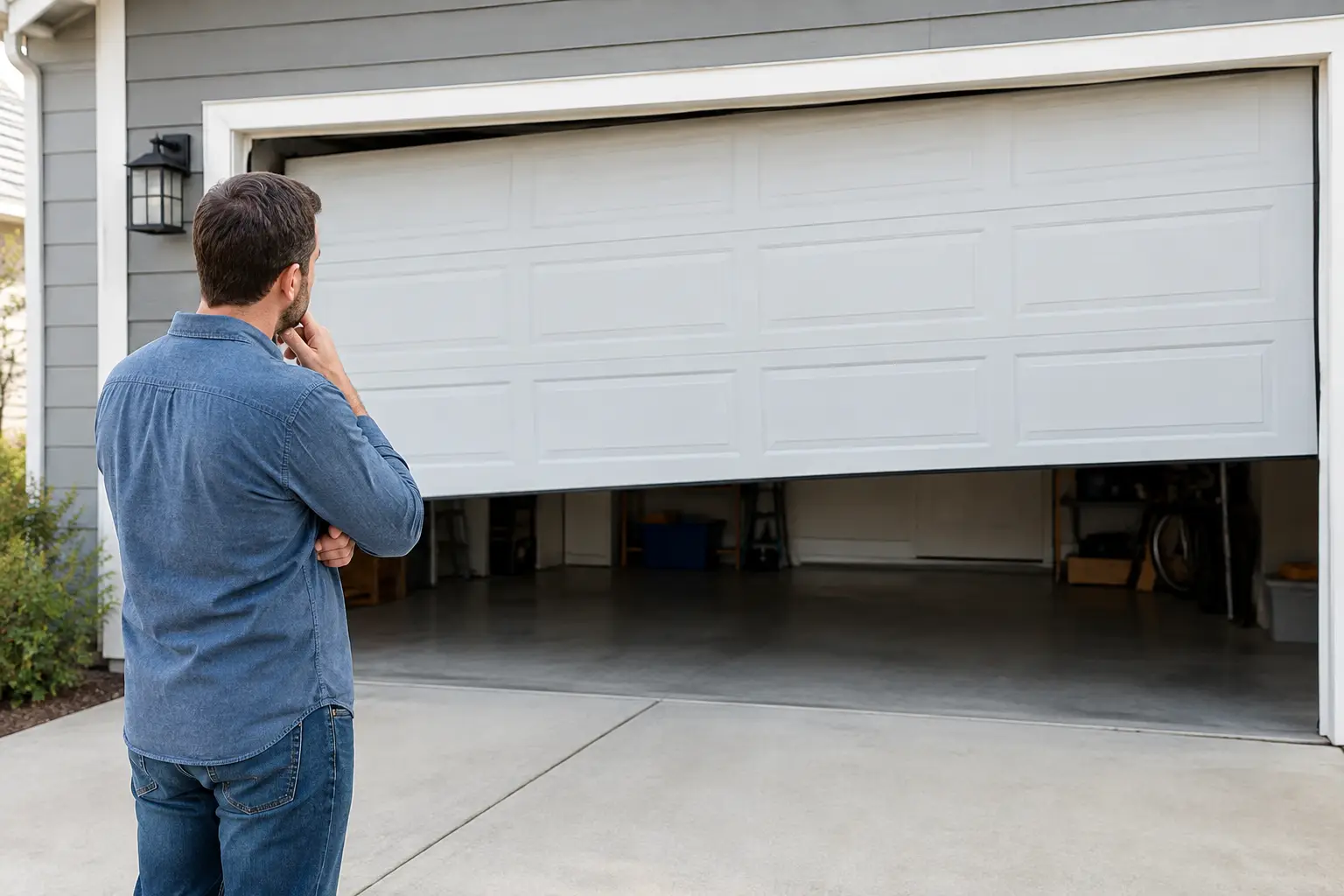
A garage door that drops lower on one side is not just annoying to watch. When a garage door closes unevenly, it can leave your garage unsecured, strain the opener, damage panels and tracks, or create a real safety risk for anyone nearby. The door may still move today, but an uneven closing pattern often points to a cable, spring, roller, track, or balance issue that can worsen without warning.
If the door is crooked, making new noises, stopping partway down, or leaving a gap at the floor, stop using it until the cause is identified. A quick visual check can be useful. Repairs involving springs, cables, or the door’s lifting system should be left to a qualified technician.
What an uneven-closing garage door looks like
An uneven door does not always fail in the same way. One side may reach the floor first while the other hangs several inches above it. The door may tilt as it travels, scrape a track, bind near the bottom, or reverse after touching the floor. In some cases, the door seems level until the last few feet of travel.
Look for signs that the issue is more than a minor adjustment. A loose or hanging cable, a visible gap in a torsion spring, bent track sections, rollers that jump or wobble, or a door that feels unusually heavy all call for prompt service. Do not keep cycling the opener to see whether it will correct itself. Repeated operation can turn a repairable part failure into damage to the opener, panels, or track system.
Why a garage door closes unevenly
Garage doors are heavy moving systems. Their springs offset the door’s weight, cables lift each side at the same rate, rollers guide the sections through the tracks, and the opener moves a properly balanced door. When one part is out of place or worn, the result can be a door that closes crookedly.
A cable has slipped, frayed, or broken
A cable problem is one of the most common reasons a door drops unevenly. Cables run from the bottom brackets of the door to drums near the spring system. If one cable slips off its drum, frays, loses tension, or breaks, one side of the door is no longer being supported correctly.
You may notice a cable hanging beside the door, wrapped unevenly around the drum, or caught in the track area. The door can become badly crooked very quickly. Do not pull on the cable or try to rewind it yourself. Cables are under high tension and are connected to the spring system. A technician needs to secure the door, inspect the full lifting system, and reset or replace the affected components safely.
A spring is broken or losing tension
A broken torsion spring often causes a door to feel heavy and may contribute to uneven travel, especially if a cable has also shifted. Extension-spring systems can create uneven movement when one spring breaks, stretches out, or no longer provides matching lift on both sides.
A torsion spring may have a visible separation in its coils. You may also hear a sharp bang from the garage when it breaks. Because springs store a significant amount of energy, spring replacement is not a DIY job. The correct spring size, winding, cable condition, and door balance all need to be checked together.
Tracks, rollers, or hinges are damaged
A dented vertical track, loose track bracket, worn roller, or damaged hinge can keep one side of the door from following its normal path. This is more likely after a vehicle bumps the door, a bicycle or stored item catches the track, or years of vibration loosen mounting hardware.
Minor roller noise does not always mean the door will fail. But if the door rubs metal, shakes hard, comes out of the track, or has a roller that is visibly outside the track channel, stop operation. Forcing it down with the opener may bend the track further or pull the door out of alignment.
The door is out of balance
A correctly balanced door should not rely on the opener to lift its full weight. When spring tension is uneven or the springs are worn, one side may lag, the door may travel roughly, and the opener has to work harder than it should.
Balance can only be evaluated safely after the door is disconnected from the opener and controlled by hand. Because a door with a spring or cable issue can drop unexpectedly, this is best handled by a garage door professional. The repair may be a spring adjustment or replacement, but the proper fix depends on the door’s size, weight, hardware, and condition.
The opener is exposing an existing problem
An opener can cause trouble, but it is not always the original cause of a crooked door. A worn gear, damaged rail, loose mounting point, or incorrect travel setting can affect how the door moves. More often, however, the opener is struggling because the door is already unbalanced or binding in the tracks.
If the door moves evenly by hand but behaves unevenly only with the opener, an opener inspection makes sense. If it is crooked whether operated manually or automatically, the lifting hardware and tracks need attention first. Adjusting opener force settings is not a safe workaround for a door that is binding or out of balance.
What you can safely check before calling
There are a few observations that can help describe the problem clearly. With the door closed and the opener unplugged if practical, look from a safe distance for a broken spring, loose cable, bent track, damaged roller, or gap beneath one side of the door. Notice whether the problem began after an impact, power outage, cold weather, or a loud snap.
You can also make sure nothing is blocking the photo-eye sensors near the bottom of the tracks. Wipe the lenses gently and confirm that both sensor brackets are facing each other. Misaligned sensors usually make a door reverse or refuse to close, rather than make it physically crooked, but they can create a separate closing issue.
Do not loosen track bolts, bottom brackets, cable drums, spring hardware, or red emergency-release components on a crooked door. Do not stand beneath a partially open door. If the door will not close securely, keep people and vehicles clear of the opening and arrange service as soon as possible.
When an uneven door is an emergency
Treat the situation as urgent when the door is hanging at an angle, off its tracks, supported by only one cable, or stuck open over a vehicle or entry point. A door in this condition can fall or shift suddenly. It also leaves a home, business, inventory area, or attached garage exposed.
For commercial overhead doors, uneven closing can interrupt deliveries, tenant access, vehicle movement, and building security. The same safety rules apply, but the operational impact can be greater. Do not ask employees or tenants to force the door closed. A professional inspection can determine whether the problem is limited to a cable or roller, or whether the door, springs, tracks, and operator require repair.
The value of a complete repair, not a quick reset
Putting a cable back on a drum may restore movement, but the right repair starts with finding out why it came off. A technician should inspect cable wear, drum alignment, spring condition, shaft bearings, tracks, rollers, hinges, bottom brackets, and the door’s balance. That approach helps prevent the same failure from returning a few days later.
At Triple A Garage Doors Inc., qualified and insured technicians provide in-person evaluations and explain what is causing the issue before repair work begins. You should receive clear recommendations and upfront pricing, whether the solution is a cable replacement, spring repair, track correction, roller replacement, or opener service.
A garage door should close level, seal properly at the floor, and move without excessive strain or noise. If yours is starting to tilt, scrape, or leave one side open, addressing it now is the safer and usually less costly choice than waiting for the door to jam completely.
Leave A Comment